
Driveway material comparisons
Pavers vs Concrete Driveway
Last updated
Compare a paver driveway with poured concrete using the whole installed system. Pavers need suitable support and edge restraint, while a poured slab needs its specified support and joints. Lifting units can help future access. It cannot promise a hidden repair or fix failed ground. Ordinary paver joints do not prove permeability. Compare matched quotes and care plans before choosing from the surface pattern.
Sections9
Pavers vs concrete driveway compares individual paving units with a poured slab. Many driveway pavers are themselves concrete. Choose between whole systems.
Check how each fits the site.
Pavers vs concrete driveway: whole-system comparison
| Question | Interlocking concrete pavers | Poured concrete |
|---|---|---|
| Surface | Separate manufactured units | Concrete placed as a slab |
| Support | Specified base and bedding system | Specified ground and slab support |
| Movement detail | Unit interlock and restrained edges | Actual slab joints |
| Later access | Units may be lifted and reinstated | Defined cut and repair or panel work |
| Pattern | Unit shape and laying layout | Plain or decorative surface system |
| Drainage | Ordinary or purpose-designed permeable system | Grade and drainage detail |
Scroll for more →
The CMHA construction bulletin, revised 2022, describes interlocking concrete pavement as a system. It includes preparation below the units. The NRMCA joint leaflet explains the different role of joints in a poured slab.
Use the driveway material guide for the wider shortlist. This page focuses on driveway use rather than a decorative patio that never receives vehicles.
Base, edges and loads
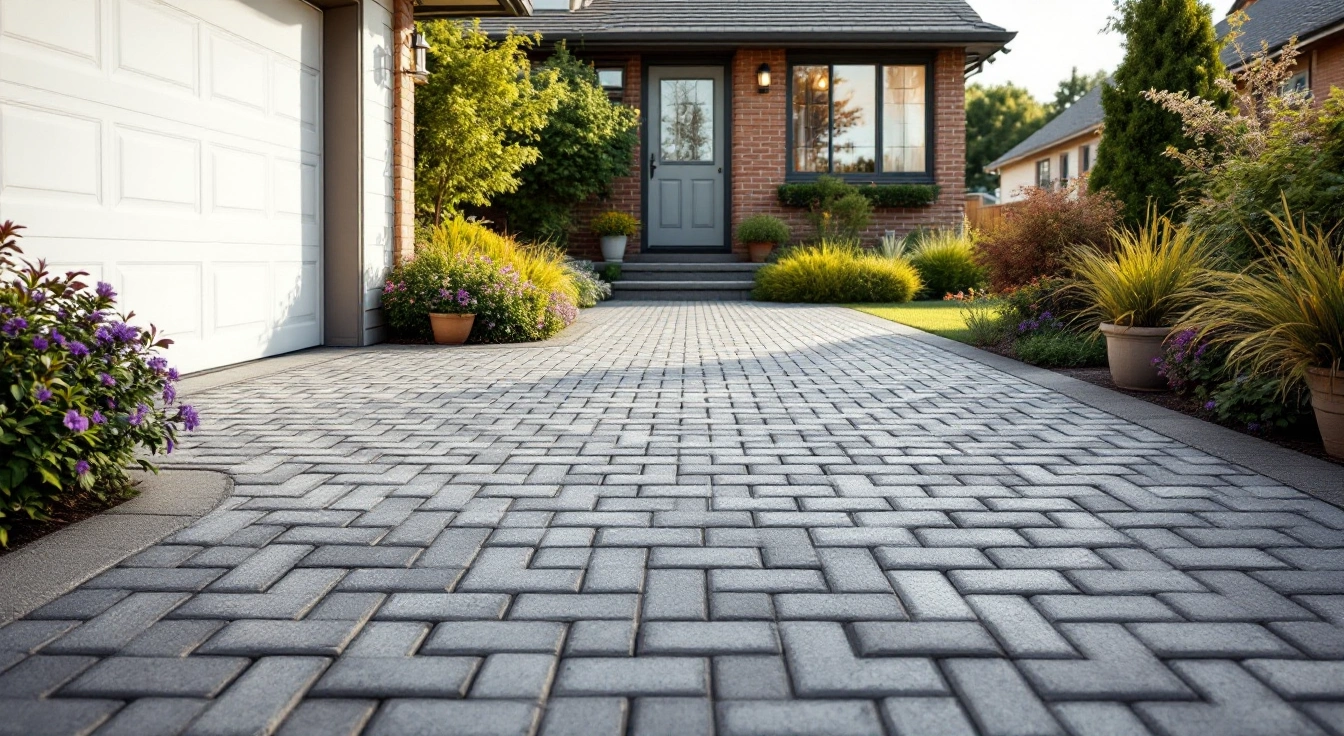
Ask the paver quote to state the base and bedding scope. Keep the intended vehicle use on the plan. A photo of neatly laid units does not show the support below them.
CMHA's edge-restraint guidance explains why edges matter to interlock. The perimeter is part of the pavement system. A planted soil edge alone should not be assumed to provide the specified restraint.
For poured concrete, record the slab and ground detail. Keep any specified steel in the scope. The driveway thickness guide explains the quantity effect of thickness without choosing a design for the loads.
Compare complete systems. Do not assume equal top-layer thickness means equal capacity. Paver unit thickness and poured slab thickness are different facts.
Matching the numbers would not prove equal performance.
Drainage and permeability
Ordinary sand-jointed paving is not automatically a designed permeable driveway. Ask whether the proposal is a permeable interlocking concrete pavement system. Its joints and layers have a defined role in water movement.
CMHA's permeable pavement bulletin describes a separate construction scope. The designer must consider the site and the water route. A wide joint or a “porous” sales description is not enough to approve drainage.
For either system, mark the garage contact and street outlet. If water must be collected, price that work. Keep any public-contact or local runoff requirement distinct from the chosen surface.
Use our slope worksheet to record geometry. It does not design a storage layer or select a legal outlet. A measured grade is one fact in a larger drainage plan.
Comparable installation budgets
HomeGuide's paver driveway guide, dated January 6, 2026, gives a broad installed range of $10 to $30 per square foot. It includes several paver materials and systems. It is not a quote for every concrete paver on the market.
For concrete, the January 13, 2026 Concrete Network plain-driveway range is $5 to $8 per square foot. The June 3, 2025 HomeGuide standard-concrete range is $6 to $10. Match their included work to the paver quote before comparing totals.
| 400-sq-ft calculated allowance | Published range applied | Result |
|---|---|---|
| Broad paver installation | $10 to $30 per sq ft | $4,000 to $12,000 |
| Plain concrete reference | $5 to $8 per sq ft | $2,000 to $3,200 |
| Standard concrete reference | $6 to $10 per sq ft | $2,400 to $4,000 |
Scroll for more →
These are planning calculations. They use different published categories. They do not establish equal site inclusions.
Match removal and base work before comparing local bids.
If you prefer stamped concrete, price that finish separately from plain concrete. The stamped driveway cost guide keeps the decorative scope visible. A stone-like poured pattern is not the same as individual pavers.
Settling and future repair access
Pavers can offer a practical route to local access by lifting units. The actual restoration still needs a plan. The units and joint material must be put back as specified.
If the ground below has moved, reusing the same units alone may not solve the cause. Ask how the supporting layers will be corrected. The ability to lift a surface is different from a guarantee that repair will be cheap.
A poured slab repair has its own boundaries. A patch or replaced panel may look different from older adjacent concrete. Keep those appearance expectations in the scope.
Save spare-unit details and the product identification for pavers. Save the mix and finish details for poured concrete. Either record can help later work, but neither promises an exact match after years of weathering.
Care, cleaning and joint material
Follow the care guide for the actual paver system. Check the method before washing near joints. Joint material has a function and should not be treated as loose dirt to remove without a plan.
CMHA's maintenance bulletin discusses distress and repair of interlocking paving. It supports diagnosing the cause rather than only renewing the visible surface. Use the actual product instructions for any cleaner or joint treatment.
Poured concrete care depends on the finish and coating. Read the driveway maintenance guide for the record to keep. Paver and slab care products need not be interchangeable.
Choosing for your household
If you expect later utility access, ask how each system would be opened and restored. Include a likely repair boundary on the drawing. That can make the tradeoff more concrete than a general claim about easy repairs.
If the first budget matters most, compare full site quotes. If appearance matters most, view actual samples at the site. Keep vehicle use and the walking route clear before approving either pattern.
Neither surface removes the need for suitable support. Choose after those facts are stated. A well-defined quote is more useful than a promise that one material is best for all driveways.
FAQ
Are concrete pavers different from concrete?
Concrete pavers are manufactured concrete units. In this comparison, “concrete driveway” means poured concrete placed as a slab. The distinction is the pavement system rather than a claim that pavers contain no concrete.
Ask which unit and support system the quote includes before comparing it with poured work.
Are pavers always permeable?
No. A permeable driveway needs a purpose-designed system with the appropriate joints and supporting layers. Ordinary unit paving should not be assumed to provide that function.
Ask for the actual water-management design and local approval basis. A visible gap between units cannot prove that the driveway meets a runoff requirement.
Can pavers be lifted for utility work?
Unit lifting may help access, but the restoration needs a defined method. Keep product records and confirm how the support and joint material will be restored. If the ground is damaged, putting back the same units alone may not solve it.
The repair can also differ in appearance after weathering.
Is stamped concrete the same as pavers?
No. Stamped concrete is a poured surface textured with a pattern. Pavers are separate units assembled into a pavement system.
A stone-like appearance can make them look similar in a photo. Their joints and repair methods differ. Compare the systems and quotes, not just the apparent stone shape.
Which costs less to install?
The published references here place broad paver installation above plain poured concrete, but their scopes differ. Get matched local bids for the same area and site work. A decorative concrete choice may cost more than plain concrete.
Keep removal and any drainage correction visible before deciding from the initial total.
Verdict on pavers vs concrete driveway
Choose pavers vs concrete driveway from the full system and site scope. Check the supporting layers and edges. Compare repair access and care alongside the budget. Keep ordinary paving separate from a purpose-designed permeable system, and approve a sample of the actual surface before work starts.