
Driveways
Stamped Concrete Driveway
Last updated
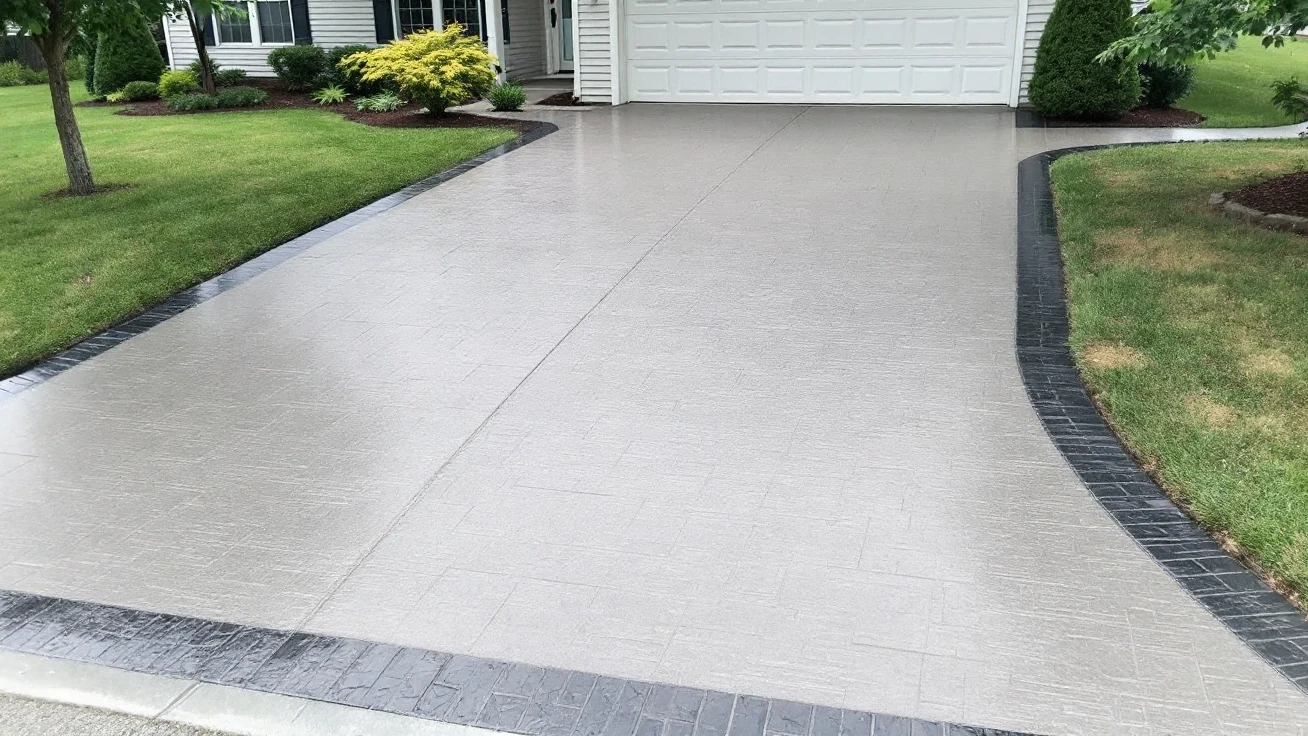
Choose a stamped concrete driveway when a defined pattern fits the site and its care needs. Set the stamp layout, color method and coating before placing. Keep true slab joints separate from decorative grooves. Check the walking route and wet finish. Price the technical pavement and finish as one clear scope, with loading release and later repair limits recorded.
Sections10
Annotated visual records
These schematic drawings explain layout choices. They are not completed jobs, product patterns or construction plans. Diagrams are not to scale; exact stamp dimensions, clearances, joints and water levels need a measured site plan.
Suggested sketch palette: Gray base / charcoal accent. Approximate screen colours only; cured colour varies. Approve the actual base, accent and coating on a physical sample.
Ashlar field with plain border
Large rectangles fill the vehicle area. Keep the border out of the required parking and door-opening space. Heavy dashed lines indicate real joints to plan separately from stamp grooves.
Brick entry accent
Limit the pattern to an entry band. Measure its area separately for pricing; vehicle turning and the clear walking strip still need space.
Texture skin around parking
A texture skin removes the fixed block repeat. It does not remove slab joints. The water arrow is a route to investigate, not a prescribed slope or outfall.
Record the exact stamp set, base and accent methods, border area, true joint layout, coating and sample date with the chosen option. Surface drawings cannot establish wet grip, slab strength or local approval.
A stamped concrete driveway combines a vehicle pavement with a decorative surface. Choose the appearance from a finished sample, then keep the slab and drainage plan intact. A stone-like pattern does not turn the concrete into paving units or establish what vehicles it can carry.
Plan the stamped concrete driveway layout
Start with the driveway's actual footprint and vehicle route. A large stamp repeat can look different on a wide parking field and a narrow entrance. Place the repeat inside a measured sketch before selecting a border.
Check how the pattern ends at the garage and street.
Single and multiple textures are described in Solomon Colors' stamped-concrete overview. Combining textures adds another placing decision, but the surface pattern still does not identify the concrete specification beneath it.
Keep the route people walk from parked cars on the layout. The surface should be judged for that daily use as well as the view from the street. A pattern that looks good in an empty driveway can behave differently under shoes or a small wheeled item.
Pattern scale and direction
Brick rows or a wood-like pattern lead the eye in a direction. A stone-like field can have an obvious repeating set too. Compare the stamp dimensions with the footprint.
A close-up can hide repetition that becomes visible across a large slab.
At a curved edge, show how the field is cut or bounded. Cropped apparent stones are part of the pattern's appearance. They are not necessarily a construction defect, but they should be expected before placing.
A border is one option for defining that edge.
Use the pattern guide to identify the exact selection. Record the chosen set rather than just asking for a “slate look.” Different stamp sets can use different apparent unit sizes and textures.
Color and coating
The base color and accent contribute to the result. Integral pigment and surface color treatment are different methods. Keep both the appearance and the work sequence in the quote.
A gray sample without the proposed coating may not show the final gloss or color.
Inspect the sample beside the house. View it dry and wet. Screen images can narrow the choice but cannot guarantee the actual outdoor color.
Retain the sample and product records.
The color guide explains why later repairs or extensions can still differ.
True joints and decorative grooves
The 2014 NRMCA CIP 6 joint guidance explains the functions of slab joints. Show the actual joints on the stamp layout: a groove resembling a masonry joint does not automatically serve the required concrete-joint function.
A contraction cut may pass through apparent stones. Decide how that will look before placing rather than expecting the stamp lines to handle every movement. Contacts with the garage or retained paving also need the specified detail.
Extra reinforcement does not promise a crack-free surface.
Slope and wet use
Drainage needs its own route to an allowed outlet. A pattern cannot correct a low point in the slab. Keep running and cross slope beside the layout, and check the garage threshold.
Price any drainage correction separately where excluded from the slab proposal.
Raised texture does not establish a universal wet-traction rating. The finish and coating need to fit the use. Check the proposed sample and evidence for any important traction claim.
A glossy photo should not be treated as proof of outdoor suitability.
The driveway slope guide separates measurement from approval. Its calculator gives geometry, not a recommended grade for every stamped driveway. Local entrance and public walking-route requirements still need their actual scope.
Vehicle loading and curing
Stamping does not choose thickness or mix properties. Keep the intended vehicles in the written pavement scope. NRMCA CIP 31, revised through 2023, explains job-specific concrete requirements.
Decorative appearance is separate from those requirements.
NRMCA CIP 11, the 2017 curing guidance, explains moisture and temperature control. The method has to fit the finish. A coating or a dry-looking surface does not give a universal date for vehicle access.
Use the curing reference to understand the source conditions and unknown cases. Keep the actual loading release with the installation record. A calendar count from another driveway does not expand the permitted use of this slab.
Maintenance and repair appearance
Keep the surface system's care instructions. Cleaning or recoating needs the method suited to those products. Do not apply a generic high-pressure cleaning rule to every stamped finish.
A harsh treatment can affect an accent or coating.
A repair can show even when the stamp set is known. Age and wear affect texture and color. The surrounding coating can also differ.
Save the original records, but don't turn them into an invisible-repair guarantee.
If future service access is likely, include the appearance of a cut-and-repair area in the decision. A stamped slab doesn't provide the same lift-and-replace route as individual paving units. Compare that practical difference alongside the desired appearance.
Define and price the finish scope
| Decision | Written scope |
|---|---|
| Field pattern | Exact stamp set and direction |
| Color | Base and accent method |
| Border | Measured extent and finish |
| Coating | Product and final appearance |
| Joints | Actual slab layout and contacts |
| Care | Installed system's instructions |
| Loading | Release conditions for intended vehicles |
Scroll for more →
The stamped driveway cost guide keeps national tiers and exclusions separate. Compare prices for this exact definition of the work. An installed package should not have concrete or stamping labor added twice.
FAQ: stamped driveways
Is a stamped driveway made of separate stones?
No. The pattern is pressed into concrete while fresh. Apparent stones or bricks are part of the surface design.
The slab still needs its technical specification and true joint plan. Do not infer unit-paving repair access, permeability or vehicle capacity from a surface that merely resembles another paving material.
Can the stamp lines replace contraction joints?
Not automatically. Decorative lines and actual slab joints serve different purposes. Show the joint layout with the pattern before placing, including any cut across apparent stones.
Check contacts with existing paving too. A more convincing surface pattern does not establish that the required movement details have been provided or that cracks cannot occur elsewhere.
Is every stamped finish suitable for a sloped driveway?
The name alone cannot establish that. Texture and coating affect the finished surface, while drainage and grade transitions need their own plan. Check a sample and relevant use evidence.
The slope calculator measures geometry, but it cannot approve the finish or determine that one pattern is suitable for every outdoor vehicle and walking route.
Will a repaired area disappear into the pattern?
An exact match cannot be promised. The stamp record helps identify the texture, but age and color treatment affect appearance too. Coating wear adds another difference.
Discuss the expected repair boundary and finish before work. A stone-like pattern should not be chosen on the assumption that every later patch will be invisible.
Verdict on a stamped concrete driveway
Choose a stamped concrete driveway from a finished sample and measured layout. Keep the actual slab joints and loading scope separate from appearance. Price the defined surface system and its exclusions. Return to the concrete driveway guide to keep drainage, quantity and installation decisions together.