
Sidewalks
Stamped Concrete Walkway
Last updated
Plan a stamped walkway from its measured clear route and fixed contacts. Choose the exact stamp set and inspect an actual sample with the intended color and coating. Keep real joints visible beside decorative grooves. A stone-like pattern does not create removable units or prove traction. Public sidewalks may have their own finish requirements, so check that scope separately. Retain product and care records for later maintenance and repair.
Sections13
- Stamped concrete walkway planning checklist
- Private walkway and public sidewalk
- What the pattern is
- Pattern scale on a narrow path
- Color and coating
- Walking use and surface evidence
- Real joints and support
- Water route and levels
- Dated price context
- Installation and curing records
- Later repair and renewal
- FAQ
- Verdict on a stamped concrete walkway
Annotated visual records
These schematic drawings explain layout choices. They are not completed jobs, product patterns or construction plans. Diagrams are not to scale; exact stamp dimensions, clearances, joints and water levels need a measured site plan.
Suggested sketch palette: Terracotta base / umber accent. Approximate screen colours only; cured colour varies. Approve the actual base, accent and coating on a physical sample.
Brick rows along the route
The small repeat follows the long route. Real joints cross the slab independently of the decorative brick grooves. Border width reduces the remaining field.
Ashlar on a curved path
Large blocks are cropped at a bend. Lay out the actual stamp repeat before approval and test relief under small wheels.
Texture skin with a border
The field has texture without a fixed repeat. The clear path, joints and doorway remain separate checks. No slip rating is inferred from a drawing.
Record the exact stamp set, base and accent methods, border area, true joint layout, coating and sample date with the chosen option. Surface drawings cannot establish wet grip, slab strength or local approval.
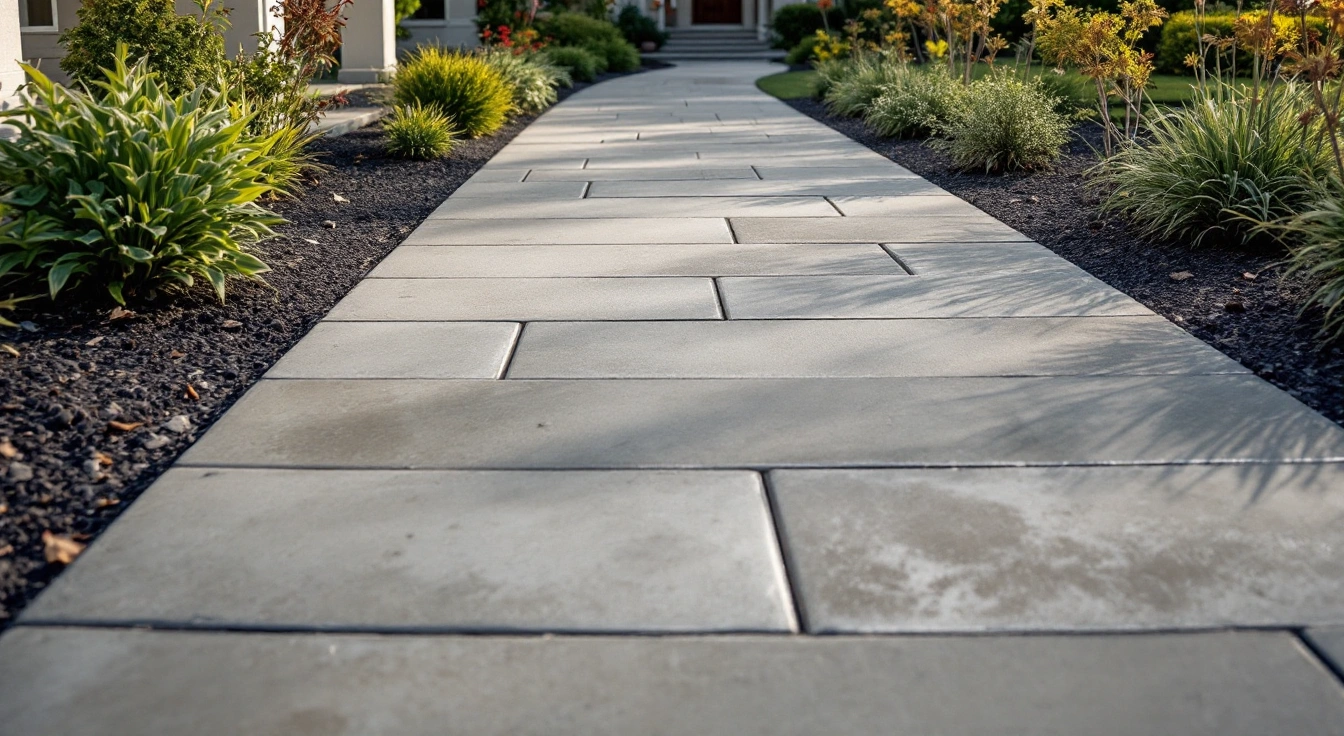
A stamped concrete walkway uses texture in a poured surface to suggest stone or another pattern. Start with the route and actual users. Then approve the pattern and coating as one defined system.
Stamped concrete walkway planning checklist
| Decision | Record to keep | Limit to resolve |
|---|---|---|
| Route | Measured path and clear space | Pattern should not determine useful access |
| Pattern | Exact stamp set and scaled layout | Edge cuts and repeat need approval |
| Color | Base and accent method | Screen color is not the accepted sample |
| Coating | Actual product and finish | Appearance is not a traction rating |
| Slab | Section and supporting work | Finish does not prove capacity |
| Joints | Functional layout beside the pattern | Grooves are not assumed real joints |
| Setting | Private or public work scope | Local finish rules may govern public work |
Scroll for more →
Return to the sidewalk guide for the whole project. Use sidewalk ideas to compare layouts before selecting a pattern. The surface should serve the route rather than crowd it.
Private walkway and public sidewalk
Identify the actual setting first. A private garden route differs from a public sidewalk next to the street. The public scope can require a specific detail or finish.
For a named local example, Portland P-551, effective April 17, 2019, specifies a light broom finish within its scope. That drawing does not approve stamping on every public sidewalk. Check the responsible authority before pricing a decorative alternative.
U.S. Access Board public right-of-way guidance addresses its defined setting. A photo or surface sample cannot certify route compliance. Keep the actual access requirements with the project plan.
What the pattern is
Stamped texture is part of poured concrete. It can suggest separate pieces while remaining one slab system. The apparent stones or boards are not individually lifted for service access.
Brickform's stamp information shows distinct named selections. Record the actual set. A broad request for a “slate look” can leave texture and unit scale open.
If removable units are important, compare a paver system separately. The paver patio comparison explains the system distinction for pedestrian space. Public paving still needs its own governing detail.
Pattern scale on a narrow path
Place the selected pattern on a scaled route drawing. Show the apparent units at edges and corners. A large stone pattern may be heavily cropped on a narrow walkway.
Ask whether that crop is part of the intended look. A border may define the edge differently. Keep its exact area or length in the quote.
Use the stamped pattern guide for the selection record. View enough of the sample to understand repetition. A close texture image can hide how the full route reads.
For a directional pattern, compare its orientation with the path. Check the doorway contact and any curve. Do not leave those details to be decided after the forms are set.
Color and coating
Identify the base color and any accent. Integral pigment and a surface treatment are different work stages. Keep the proposed method with the rate.
Read stamped concrete colors before approving only a shade name. Inspect the sample beside the house. View it in the light the route receives.
Ask whether the intended coating is included on the sample. Sheen can change the look. A gray uncoated example is not the same visual record as a glossy finished surface.
Save the accepted sample details and products. They can help later repair, though weathering may still make a new patch look different. The record is not a match guarantee.
Walking use and surface evidence
Discuss the actual users and route. Include mobility aids or small wheels where relevant. A rough texture can look suitable in a photo without establishing how it performs in use.
Ask for product-specific outdoor-use information for the coating. Keep that evidence separate from appearance. This page does not assign a traction rating from a pattern name or image.
Check raised edges and adjoining contacts on the plan. A decorative border should not reduce useful clear space. Planting at maturity needs to leave the route workable too.
Real joints and support
NRMCA CIP 6 explains functional joints in slabs. Show them beside the stamp layout. A decorative groove may not be built to serve the same role.
Keep the sidewalk thickness and support scope clear. The finish cannot choose the section. A crossing may need another detail because its vehicle use differs.
Read reinforcement planning for that part of the scope. A costly pattern does not approve heavier loads or replace specified steel. Appearance should not obscure the technical plan.
Water route and levels
Mark the doorway contact and where water leaves the path. Include any step or public contact. One measured line cannot establish the whole surface's drainage.
For a private layout, the patio slope guide explains rise-over-run math and its limits. It is not a public sidewalk approval tool. Use the actual route requirements for that scope.
Do not treat texture as a correction for a low point. The surface can still retain water. Keep outlet work visible in the budget if it is outside the decorative package.
Dated price context
For a stamped path 4 feet wide, the February 3, 2026 HomeGuide sidewalk guide gives $10 to $21 per square foot. That scope includes concrete and stamping with minimal ground preparation, so confirm any additional preparation separately.
At 200 square feet, multiplying those rates gives a $2,000 to $4,200 planning allowance. It is not a local quote or proof that all ground work is covered. Confirm access and preparation for the actual route.
Use sidewalk cost to keep area and rate units clear. Count material and decorative work once when included in a package. A finish-only rate has a different scope.
Installation and curing records
Keep the concrete order tied to actual use and exposure. Retain the delivery and accepted change record. A pattern name does not describe the mix below it.
NRMCA CIP 14 covers flatwork finishing, and CIP 11 explains curing. Use a work method compatible with the actual surface products. Surface drying is not a universal opening condition.
Get written access instructions for the completed work. Keep household users and deliveries within those limits. Save the actual care products and warranty scope at handover.
Later repair and renewal
Assess changing or uneven areas before adding a cosmetic treatment. Renewing color does not automatically correct support or grade. The cause should guide the repair boundary.
For a future cut, ask how the slab would be opened and restored. Apparent pattern units do not define every repair option. Keep realistic appearance expectations in the scope.
Read sidewalk replacement cost if old removal is part of the plan. Keep demolition and new decorative work separate where excluded. Do not apply a new-surface rate as the whole replacement total.
FAQ
Is stamped concrete suitable for every walkway?
Suitability depends on the actual users and surface system. Approve a sample and check relevant outdoor-use information. Public work may have governing finish requirements, so identify that scope first. A pattern name or rough-looking photo cannot establish traction or route compliance for every setting and condition.
Can the apparent stones be lifted for repairs?
No. They are texture in the poured surface rather than separate paving units. Real slab joints and repair boundaries have their own plan. Compare a defined cut-and-restoration scope with unit paving if future access matters. Do not assume every decorative groove identifies an individually removable piece.
How much does a stamped walkway cost?
Use a matching installed scope and measured area. The dated HomeGuide category here gives $10 to $21 per square foot with minimal preparation described. Confirm actual access and site work before treating the allowance as complete. A finish-only rate needs another budget layout, so count included concrete and labor once.
Will stamping hide all concrete joints?
The actual joint layout still needs to be shown. Functional lines may cross apparent stones, and decorative grooves may have another purpose. Approve a realistic drawing before work starts. The pattern alone does not provide a crack-free guarantee or justify removing joints from the planned concrete scope.
Can a new coat repair uneven stamped concrete?
A cosmetic coating does not automatically correct slab levels or failed support. Assess the cause and define the needed repair. Keep product compatibility clear before renewal. If replacement or cutting is needed, retain the actual pattern records while recognizing that a repaired area may differ from weathered adjacent concrete.
Verdict on a stamped concrete walkway
Choose a stamped concrete walkway from a useful route and accepted sample. Keep the setting's requirements and real joints clear. Price the complete surface system, then retain its work and care records. A pattern can shape appearance while support and access details continue to govern the walkway's function.